A celebration of Bengal's soul

Where art
meets the earth.

Come for the songs, stay for the stories. Discover the colour, craft and open-hearted spirit of Pousmela 2026 in beautiful Santiniketan.

♫ Baul music · Handcrafted treasures · Folk traditions
Mark the season৭ পৌষ
বাংলার প্রাণের মেলা
✳ Folk music✳ Art & craft✳ Santiniketan✳ Stories of Bengal✳ Winter traditions
News and Events

This is a Green Mela. Use of Plastic bags is strictly Prohibited.

For food stalls a valid FSSAI certificate is Mandatory


Server Time: 20-11-2026 20:36 pm

Booking has started for Previous Customers.

Stall Information Booking Status Old Customers: Book Stall
✳ Latest News✳ Actions✳ Santiniketan✳ Stories of Bengal✳ Winter traditions
Pousmela 2026: The Carnival of Santiniketan

Pousmela 2026: December 23–28, 2026

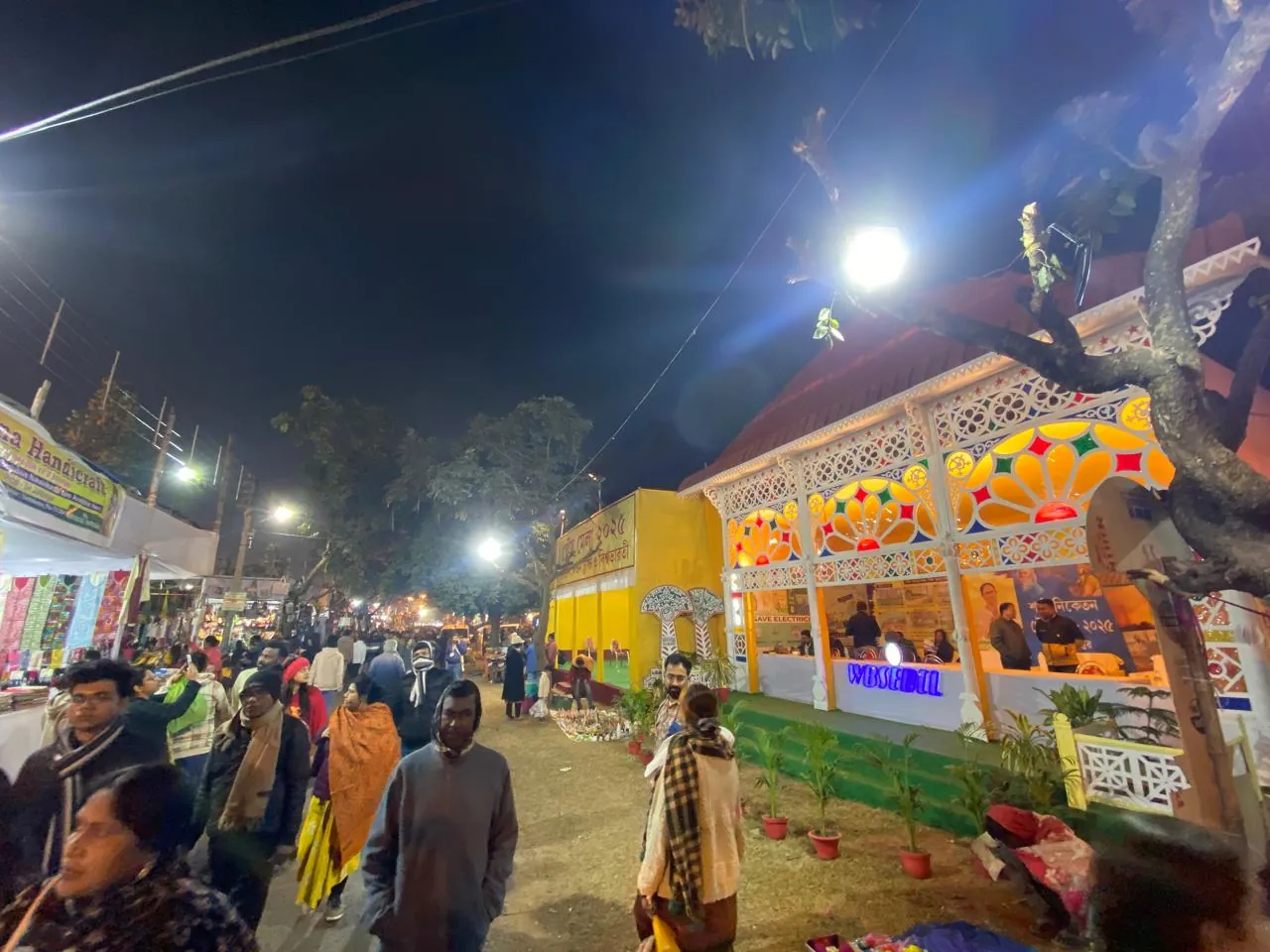
The Pousmela is organised by the Santiniketan Trust (set up by Maharṣi Debendranath Tagore on March 08, 1888) jointly with Visva-Bharati’s Karmi-Pariṣad. This year it would be a six-day fair starting on December 23, 2026, and ending on December 28, 2026. As in previous years, it will take place in the Purbapalli Field, i.e., Melār Maṭh (adjacent to the Central Administrative Buildings).

A Brahma mandir was established at Santiniketan on December 21, 1891 (7 Pouṣ 1298 BS). A small fair was organised in 1894 in connection with the establishment anniversary of the Brahma mandir, in the ground opposite the mandir. What started as a small rural fair, the Pouṣ Melā now attracts hundreds of thousands of people from all over the country and the world. From 1894 onwards, the Pouṣ Melā has been organized every year. However, it had been put on halt for three times due to the Bengal Famine of 1943, the Direct Action Day of 1946 and the COVID-19 pandemic. In the initial years the melā (fair) was held in the field (presently known as the Jagadīśa Kānana) situated on the north side of the Brahma mandir or Upāsanā Gṛha. A firework display was held in the earlier days after the evening prayers. This has been discontinued, taking cognizance of environmental concerns. As the melā increased in size and scope, it was shifted to the Melār Maṭh.

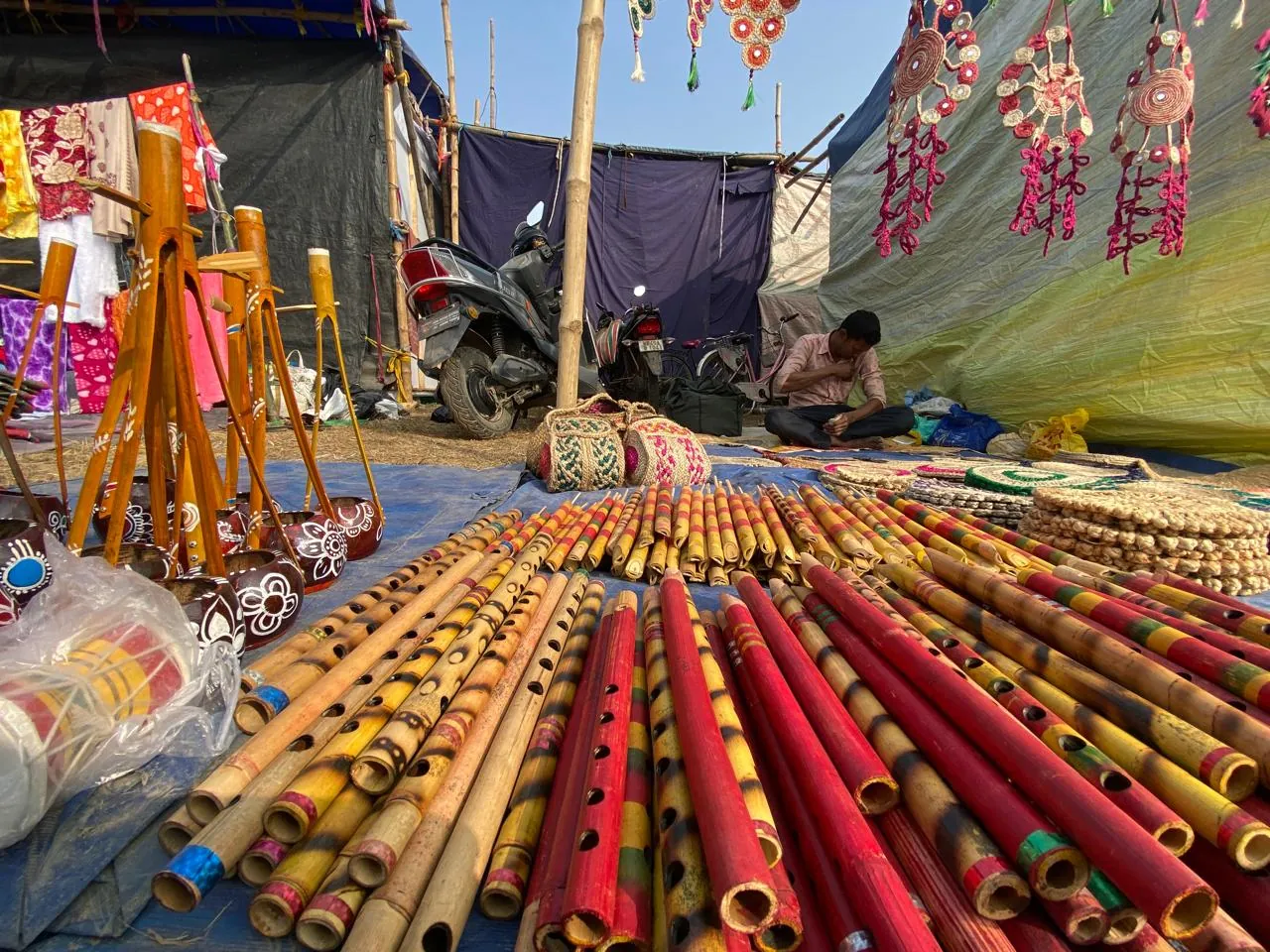
The original intention behind the Pouṣ Melā was to create a platform of interaction between the rural community and the relatively urban followers of Bramhoism who gathered at Santiniketan during the fair. The villagers were allowed to showcase and sell their products, and the Pouṣ Melā authorities provided added entertainments of elaborate firework sessions, Jatra Palas (popular open-air theatre), folk music renditions, etc. A pure ceremonial religious meet to deliberate and perhaps propagate Bramhoism on 7th Pouṣ, thereby, charted a new course of interacting with rural people and tribal folks surrounding Santiniketan.


Rules to be followed
♫

Pous Mela & Pous Utsava

Today, the Pouṣ Melā runs parallel to the Pouṣ Utsava but, of late, extends for a few days beyond the Pouṣ Utsava. This year, for instance, it will be held for six days in the Melār Maṭh. The Karmi-Pariṣad, as usual, will organise all-day cultural programmes for the first four days of the Melā at the Cultural Stage set up in the Purbapalli Field.

✿

Transparency

To ensure transparency and greater accessibility, booking of all stalls will be done online on a first-come-first-served basis, though preference may be given to organisations who put up stalls every year. Artisans will be given preferences in the mela

✺

Challenges

Despite its enduring charm, the Pouṣ Melā has faced several challenges over the years. The influx of large crowds and commercialization has raised environmental issues. The University is committed to upholding the highest standards of environmental sustainability in organising this fair. Working closely with the district administration, the University will also endeavour to guarantee the greatest extent of civic and logistical facility while the fair is held.
Pous Utsava 2026

07–09 Pouṣ (December 23–25, 2026)

Maharṣi Debendranath Tagore, with twenty followers, took dīkṣā or accepted the Brahmo creed from Ram Chandra Vidyabagish on 21 December 1843 (07 Pouṣ 1250 BS). This event rejuvenated the Brahmo Movement following the death of its founder, Raja Rammohun Roy and forms the basis of Pouṣ Utsava (the Festival of Pouṣ) at Santiniketan. All the events associated with the Pouṣ Utsava take place within the āśrama area— now a UNESCO-inscribed World Heritage Site— over three days (07–09 Pouṣ). Presently, 07–09 Pouṣ commonly coincides with 23–25 December of the Gregorian calendar.

Day One of the Pouṣ Utsava 2026 (06–07 Pouṣ/22–23 December)

  • Dusk Baitālik (or ceremonial procession) will take place on 06 Pous (22 December) at 9 p.m. from the Gaura Prāṅgaṇa. As is customary, the song of the Baitālik will be the Rabindra Sangeet: āji jato tārā tabo
  • Shehnai will be played at the Santiniketan Gṛha from 09.30 p.m. on 06 Pouṣ (22 December).
  • Upāsanā (prayer-meeting) at Chātimtalā will be held from 07.30 a.m. commemorating the dīkṣā divasa of Maharṣi Debendranath Tagore. This is probably the most auspicious event in Santiniketan’s calendar of functions and festivals. As is customary, the Hon’ble Vice-Chancellor of Visva-Bharati will officiate as the Ācārya, and his address will be accompanied by the chanting of Vedic mantra (by Shri Soumyen Sengupta) and the recital of their Bengali translation (by Dr. Subhayu Chattopadhyay). Songs will be performed by the students and staff of Saṅgīt-Bhavana. Before the commencement of the Upāsanā, students and staff of Kalā-Bhavana will adorn the entire Chātimtalā with Ālpanā (a traditional Bengali folk artform where intricate, hand-painted white or coloured motifs are created on floors and walls by hand). The Upāsanā inaugurates the Pous Melā. No separate ceremony is held. The Chātimtalā is circumambulated after the conclusion of the Upāsanā, accompanied by the song Karo tāro nāmo gān, a Brahma-Sangeet composed by Dwijendranath Tagore. The procession then proceeds to Udayana Gṛha, singing the Rabindra-Sangeet, Āguner paraśmaṇi.
  • Āloksajjā (candlelight decoration) at Chātimtalā from 06.00 p.m.

Day Two of the Pouṣ Utsava 2026 (08 Pouṣ/24 December)

  • Shehnai will be played at the Santiniketan Gṛha from 06.00 a.m. on 08 Pouṣ (24 December). 08 Pouṣ is important for the Sāmvātsarik Utsava O Pāṭha-Bhavana–Śikṣa-Satra-er Nidarśana Patra Pradāna (Annual festival and presentation of certificates to the students of Pāṭha-Bhavana and Śikṣa-Satra). During this ceremony, a pravīṇa (usually an elderly ex-student) hands over a lamp to a navīna (current young student) in a symbolic gesture of bequest of wisdom and tradition. An invited Chief Guest will be present during the event. Pāṭha-Bhavana and Śikṣā-Satra will organise this event, perform the songs, as well as take care of the Ālpanā. The event will take place at the Jawhar Bedī of Āmrakuñja.
  • Debendra Smārak Baktṛtā (memorial lecture) will be organised by the Department of Philosophy and Comparative Religion from 03.00 p.m. at the Conference Hall of the Department at Darśan-Sadana. This year Prof. Emeritus Raghunath Ghosh will deliver the lecture and it will be chaired by Prof. Sudip Basu, Director, Culture and Cultural Relations, Rabindra-Bhavana, Visva-Bharati.

Day Three of the Pouṣ Utsava 2026 (09 Pouṣ/25 December)

  • Shehnai will be played at the Santiniketan Gṛha from 06.00 a.m. on 09 Pouṣ (25 December).
  • Paralokagata Āśrambandhuder Smṛtibasara (a memorial gathering for the departed friends of the āśrama) will be held at the Carmichael Bedī of Āmrakuñja from 08.00 a.m. It will be presided over by the Hon’ble Vice-Chancellor. As is customary, deceased members of the Visva-Bharati community will be remembered; there will be mantrapāṭha (chanting of mantras), songs by Saṅgīt-Bhavana, and reading from Rabīndra Racanā by Shri Tarit Roychowdhury.
  • Haviṣyānna (ceremony of partaking of oblative food) will be held at the Pāṭha-Bhavana kitchen in the afternoon.
  • Khṛstotsava, commemorating the birth of Christ, will be held at Upāsanā Gṛha from 06.00 p.m. Prof. (Retd.) Abhijit Sen will officiate as the ācārya. Passages from the Bible will be read by Dr. Atig Ghosh; Christmas carols and Rabindra-Sangeet will be performed by Saṅgīt-Bhavana, along with the recital of Vedic Mantra.

Getting here

Follow the red earth road.

Santiniketan is in Birbhum district, West Bengal. Bolpur is the main rail gateway for most visitors.

🚆

By train

Travel to Bolpur Shantiniketan (BHP) station. Trains connect with Howrah and other major stations; check schedules for your travel date.

🚗

By road

Reach Bolpur by road from Kolkata and nearby towns. Allow extra time during mela days for traffic and parking.

✈️

By air

The nearest major airport is Netaji Subhas Chandra Bose International Airport, Kolkata; continue by train or road.

🧭

Before you go

Check the latest venue, entry, parking and programme information from event organisers before travelling.

Pousmela 2026 GroundsSantiniketan, Bolpur, West Bengal
Open in Google Maps ↗
শান্তিনিকেতনে দেখা হবে

Come curious.
Leave with a story.

Celebrate the makers, music and memories of Bengal's beloved winter fair.

Back to the beginning ↑